
Last Updated:
India’s first passenger train ran on April 16, 1853, from Mumbai to Thane, covering 34 km in 1 hour 15 minutes.

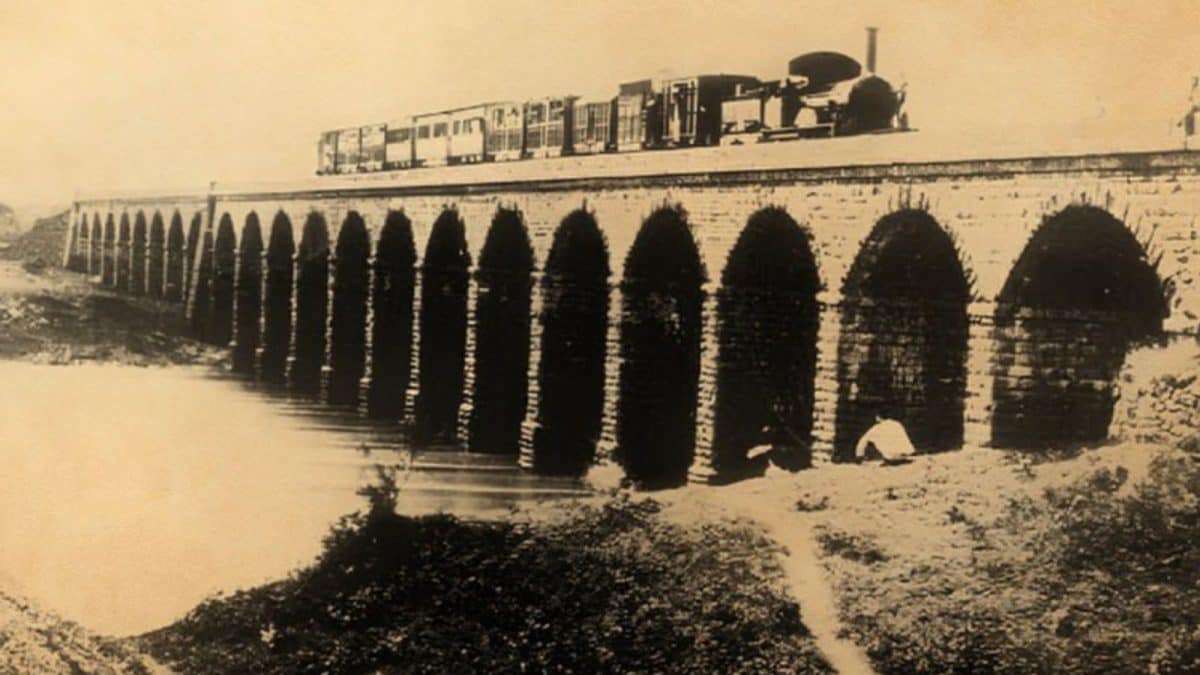
The first Mumbai-Thane train in 1853 carried around 400 passengers. (Photo Credit: X)
On April 16, 1853, India witnessed a moment that changed its future forever. A train carrying around 400 passengers set off from Bori Bunder in Mumbai to Thane, covering a distance of 34 km in one hour and fifteen minutes. It was the country’s first passenger train service, and it marked the beginning of a journey that would eventually transform India’s economy, society, and connectivity.
The historic ride was operated by three locomotives named Sahib, Sultan, and Sindh, pulling 14 wooden carriages. The train left the station at 3:30 pm, cheered on by thousands of onlookers and accompanied by a 21-gun salute.
ALSO READ| Mumbai Metro 4, 4A: Ride High From Wadala To Thane, Minus The Traffic At EEH, LBS & Ghodbunder
For many, this was their first time seeing or sitting on a train, and the excitement was unmatched. What began as a short suburban service became the foundation for one of the largest railway networks in the world.
The first passenger train laid the tracks for modern India
The inaugural journey between Mumbai and Thane is often remembered as the dawn of modern transport in India. Unlike other countries where railways faced resistance, Indians quickly embraced this new mode of travel. Cheap, quick, and relatively safe, it soon became the backbone of movement across the subcontinent.
The idea of rail travel in India had been in the works decades earlier, with experimental tracks laid in Madras. But it was the Mumbai-Thane run that brought the dream to life and proved the potential of a railway system for the masses.
By August 1854, trains had started operating in the east between Howrah and Hooghly. Soon after, the south and north followed, with lines in Madras and Mathura by the mid-1870s.
In 1853, exactly 171 years ago today, India marked a significant milestone in transportation history with the inaugural journey of the first train from Bori Bunder to Thane. This pivotal moment heralded a new era of connectivity that shaped the nation’s future.#CentralRailway… pic.twitter.com/z61ynx0hnh— Central Railway (@Central_Railway) April 16, 2024
The railway network grew rapidly across the country
From that first short journey in 1853, India’s railways expanded at an astonishing pace. By 1880, the country already had 9,000 km of track, despite political upheavals like the 1857 First War of Independence. The network connected towns, cities, and villages, carrying not just people but also goods and livestock.
Over time, the railways became more advanced. In 1925, India saw its first electrified section between Mumbai’s Victoria Terminus (now CSMT) and Kurla Harbour.
Later, diesel engines were introduced but were eventually phased out as oil prices rose. Today, more than 80 per cent of the network is electrified, making it faster, cheaper, and more sustainable.
From colonial beginnings to a national lifeline
During British rule, multiple private companies and princely states operated separate railway lines. After Independence, the government brought them all together under a single entity in 1951, creating Indian Railways. This step turned the fragmented network into a unified system that could serve the entire nation.
Now, Indian Railways is the fourth-largest railway network in the world, reportedly covering more than 108,000 km. It carries over 23 million passengers every day, an achievement that began with just 400 people on that first trip from Mumbai to Thane.
The network includes everything from long-distance express trains to luxury tourist specials like the Palace on Wheels, as well as modern Vande Bharat trains.
The journey that created a lasting legacy
That first ride in 1853 was more than just a new transport service. It was the start of a system that would power India’s modernisation, link far-flung regions, and become one of the country’s strongest symbols of progress.
More than 170 years later, Indian Railways remains the nation’s lifeline, continuing to expand and adapt while carrying forward the legacy of that one historic journey.
- Location :
Delhi, India, India
Read More